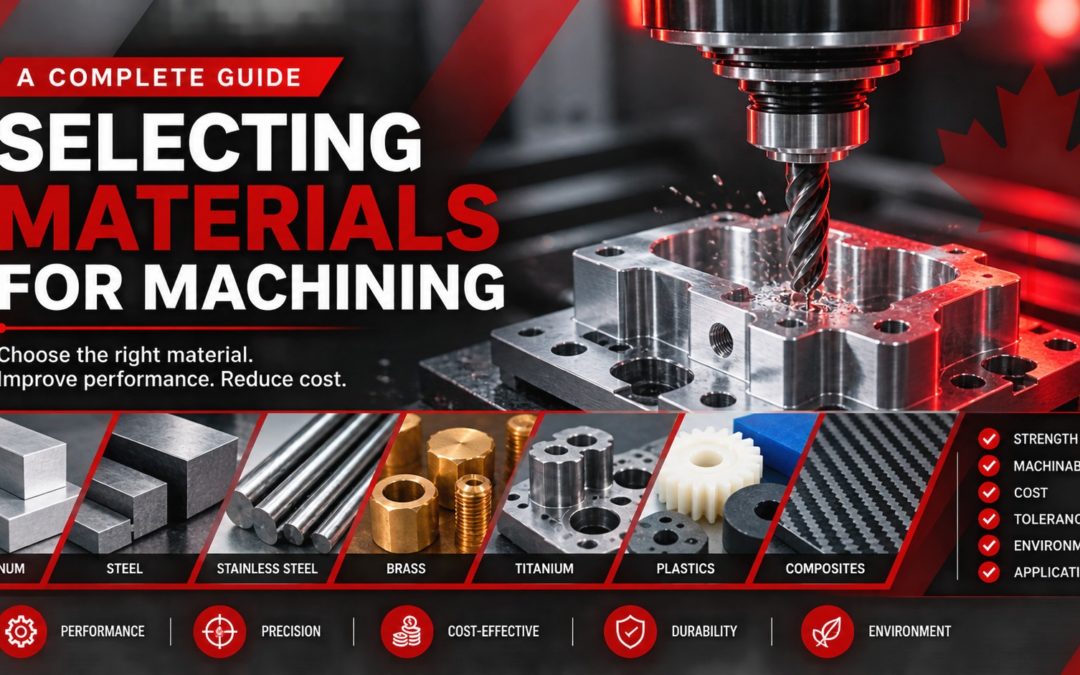
Selecting the right material for a CNC machined part is one of the most important decisions in the manufacturing process. Material choice affects far more than the finished part’s strength or appearance. It can influence machining time, tool wear, dimensional stability, surface finish, production cost, lead time, finishing options, and the long-term performance of the component.
There is no single best material for CNC machining. Aluminum may be an excellent choice for one component, while stainless steel, titanium, brass, acetal, PEEK, or another engineering material may be better for another.
The right choice depends on what the part needs to do, where it will operate, how it will be manufactured, and what performance and quality requirements it must meet.
This guide explains how to select materials for CNC machining, compares commonly used metals, plastics, and composites, and covers the practical factors engineers, product designers, purchasing teams, and manufacturers should consider before production.
Why Material Selection Matters in CNC Machining
Material selection should happen early in the design and manufacturing process—not after the part has already been designed.
The material influences:
- Part strength and stiffness
- Weight
- Wear resistance
- Corrosion resistance
- Temperature performance
- Electrical and thermal conductivity
- Dimensional stability
- Machinability
- Tool life
- Surface finish
- Achievable tolerances
- Heat-treatment requirements
- Surface-finishing options
- Material availability
- Manufacturing lead time
- Overall CNC machining cost
For example, aluminum is often attractive because it combines low weight, good machinability, and useful strength. A higher-strength aluminum such as 7075 may be appropriate when the application requires more mechanical performance than 6061 can provide. Stainless steel may be preferable when corrosion resistance and durability are more important than weight. Titanium may justify its higher material and machining cost when its strength-to-weight ratio and corrosion performance provide a meaningful advantage.
The important point is that material selection should be based on the requirements of the finished component rather than simply choosing the strongest, cheapest, or most commonly used material.
How to Choose the Right Material for a CNC Machined Part
A practical material-selection process starts with the part’s requirements and gradually narrows the available options.
1. Define What the Part Needs to Do
Start with the function of the component.
Ask:
- Will the part carry a structural load?
- Will it experience impact or vibration?
- Will it experience repeated loading?
- Does it need high wear resistance?
- Does it need to remain lightweight?
- Does it need electrical conductivity or insulation?
- Will it be exposed to chemicals?
- Will it operate at elevated temperatures?
- Does it need a particular appearance?
- Will it contact food, pharmaceuticals, or the human body?
- Does it require very tight dimensional tolerances?
A material that looks ideal based on one property may perform poorly when the complete operating environment is considered.
2. Consider the Operating Environment
The environment in which the component will operate can eliminate otherwise suitable materials.
Consider exposure to:
- Heat and cold
- Moisture
- Salt water
- Humidity
- Chemicals
- Oils and lubricants
- UV exposure
- Abrasion
- Repeated friction
- Vibration
- Vacuum
- Electrical current
- Biological environments
For example, a material that performs well in a dry indoor application may not be appropriate for a marine or outdoor environment where corrosion resistance becomes a primary consideration.
3. Identify the Required Mechanical Properties
Mechanical properties are often the starting point for material selection.
Strength
Strength describes a material’s ability to withstand applied loads without failure. Depending on the application, tensile strength, yield strength, shear strength, or compressive strength may be important.
Hardness
Hardness describes resistance to indentation, deformation, and wear. Higher hardness can be useful for wear-resistant components, but harder materials are not automatically better for every application. Increased hardness can also make machining more difficult and increase tool wear.
Toughness
Toughness describes a material’s ability to absorb energy before fracturing. A component exposed to impact or shock loading may require toughness in addition to high strength.
Ductility
Ductility describes how much a material can deform before fracture. It can be important when a component needs to tolerate deformation rather than fail suddenly.
Fatigue Resistance
Parts subjected to repeated loading may need good fatigue performance. Shafts, brackets, structural components, and rotating parts are examples where fatigue can become an important design consideration.
Stiffness
Stiffness determines how much a component deflects under load. Elastic modulus is therefore important when dimensional or positional stability matters.
A material can be strong but relatively flexible, so strength and stiffness should not be treated as the same property.
Thermal Properties to Consider
Temperature can affect both material performance and machining accuracy.
Heat Resistance
If a component operates at elevated temperatures, consider whether it can maintain its strength, stiffness, dimensional stability, and chemical resistance at the operating temperature.
Thermal Expansion
Materials expand and contract as temperature changes.
This matters particularly for:
- Tight-tolerance components
- Precision assemblies
- Large components
- Components exposed to significant temperature changes
- Parts manufactured and used at substantially different temperatures
Thermal Conductivity
Thermal conductivity affects how efficiently heat moves through the material.
It can be particularly important for:
- Heat sinks
- Heat exchangers
- Electrical components
- High-temperature components
- Machining processes where heat management is important
Copper, for example, is highly valued for thermal and electrical conductivity, while some engineering plastics have much lower thermal conductivity.
Chemical and Corrosion Resistance
Material selection should also account for chemical exposure.
Consider whether the part will encounter:
- Water
- Salt
- Acids
- Alkalis
- Solvents
- Cleaning agents
- Industrial chemicals
- Oils and fuels
Stainless steel, certain aluminum alloys, titanium, and engineering polymers can offer useful corrosion or chemical resistance, but the appropriate choice depends on the specific environment.
Corrosion resistance should also be evaluated alongside surface treatment, galvanic compatibility, temperature, and the other materials that will contact the component.
Electrical Properties
For electrical and electronic applications, material selection may depend on:
- Electrical conductivity
- Electrical resistance
- Dielectric strength
- Insulation
- Static dissipation
- Thermal conductivity
Copper is commonly selected where high electrical conductivity is required, while engineering plastics can provide electrical insulation.
Aluminum can also be useful where electrical conductivity must be combined with low weight and good thermal performance.
Physical Properties That Should Not Be Overlooked
Mechanical and thermal properties are important, but several physical characteristics can also affect manufacturing performance.
Density
Density directly affects part weight.
This makes it particularly important for:
- Aerospace components
- Robotics
- Automotive components
- Portable equipment
- Moving assemblies
Dimensional Stability
Dimensional stability matters when the component must maintain its dimensions during manufacturing and service.
Consider:
- Thermal expansion
- Moisture absorption
- Residual stress
- Material condition
- Part geometry
This becomes especially important with engineering plastics and thin-wall components.
Moisture Absorption
Some plastics absorb more moisture than others. This can affect dimensions, mechanical properties, and long-term performance.
For precision plastic components, moisture behavior should therefore be considered before selecting the material.
Common Materials Used for CNC Machining
CNC machining can be used with a broad range of metals, plastics, and composites. However, different materials have significantly different machining characteristics.
Aluminum for CNC Machining
Aluminum is one of the most widely used materials for CNC machining because it combines relatively low weight with good machinability and useful mechanical performance.
Common aluminum grades include:
- 6061
- 7075
- 2024
- Other application-specific aluminum alloys
Aluminum 6061
6061 is a popular general-purpose engineering aluminum alloy.
Typical advantages include:
- Good machinability
- Good strength-to-weight ratio
- Relatively low density
- Corrosion resistance
- Good availability
- Versatility
- Compatibility with several finishing processes
It is commonly considered for brackets, housings, fixtures, prototypes, structural parts, and many general-purpose CNC components.
Aluminum 7075
7075 is generally selected when higher strength is required.
Compared with 6061, 7075 is commonly chosen for applications where strength and weight are more critical.
It can be appropriate for demanding aerospace, structural, and high-performance applications.
However, selecting 7075 simply because it has higher strength is not always the best decision. If 6061 already satisfies the design requirements, the additional material cost and other considerations associated with 7075 may not provide a meaningful benefit.
Related MDA service: CNC Aluminum Machining
Steel for CNC Machining
Steel provides a broad range of combinations of strength, toughness, hardness, wear resistance, and cost.
It is important to remember that steel is not one material. Different grades and conditions can behave very differently during machining and in service.
Common examples include:
- 1018
- 4140
- Tool steels
- Other carbon and alloy steels
1018 Steel
1018 is a commonly used low-carbon steel that can be suitable for general-purpose machined components.
It can be considered where:
- Cost matters
- Moderate strength is sufficient
- General machinability is required
- A relatively conventional engineering material is appropriate
4140 Alloy Steel
4140 is commonly selected when higher strength and toughness are required.
It can be used for:
- Shafts
- Gears
- Fixtures
- Machinery components
- Structural and mechanical parts
Heat treatment can further alter the mechanical properties and machining characteristics of alloy steels.
Related MDA service: CNC Steel Machining
Stainless Steel for CNC Machining
Stainless steel is often selected where corrosion resistance needs to be combined with mechanical performance.
Common grades include:
- 303
- 304
- 316/316L
- 17-4 PH
- Other application-specific grades
303 Stainless Steel
303 is a free-machining stainless steel commonly selected when machinability is an important consideration.
304 Stainless Steel
304 is a widely used general-purpose stainless steel with good corrosion resistance and broad industrial applications.
316/316L Stainless Steel
316 and 316L are commonly considered when greater corrosion resistance is required, particularly in demanding chemical, marine, food-processing, and certain medical or industrial environments.
17-4 PH Stainless Steel
17-4 PH is a precipitation-hardening stainless steel used when high strength and corrosion resistance are required.
The condition of the material and any heat treatment should be specified where relevant because these factors can affect both machining and final performance.
Brass for CNC Machining
Brass is valued for its combination of machinability, corrosion resistance, appearance, and useful electrical properties.
Free-machining brass grades such as C360 are commonly used for:
- Fittings
- Valves
- Bushings
- Electrical components
- Connectors
- Precision hardware
Brass can be an excellent choice when efficient machining and good surface quality are priorities.
Copper for CNC Machining
Copper is particularly useful when high electrical or thermal conductivity is required.
Typical applications include:
- Electrical components
- Busbars
- Heat-transfer components
- Electrical connectors
- Heat exchangers
- Specialized industrial components
Copper can be more challenging to machine than some common aluminum and brass grades, so the specific grade, part geometry, tooling, and machining strategy should be considered.
Titanium for CNC Machining
Titanium offers an attractive combination of:
- High strength-to-weight ratio
- Corrosion resistance
- Good performance in demanding environments
- Relatively low density compared with many high-strength steels
Common CNC-machined titanium materials include:
- Titanium Grade 2
- Grade 5 titanium, commonly Ti-6Al-4V
Titanium can be an excellent material where performance justifies its additional manufacturing cost.
However, titanium requires careful machining because its thermal and cutting characteristics can create significant challenges. Heat can remain concentrated in the cutting zone, and tool selection, cutting conditions, coolant, workholding, and tool engagement all matter.
Related MDA service: Titanium CNC Machining
The important takeaway is that titanium should be selected because its performance provides a genuine advantage—not simply because it is considered a premium material.
Engineering Plastics for CNC Machining
Metal is not always the best choice.
Engineering plastics can offer advantages such as:
- Low weight
- Corrosion resistance
- Electrical insulation
- Low friction
- Chemical resistance
- Ease of machining
- Reduced noise
- Useful wear characteristics
Common CNC-machined plastics include:
- Acetal/POM/Delrin
- Nylon
- ABS
- Polycarbonate
- PTFE
- PEEK
- UHMW-PE
- PEI and other high-performance polymers
Acetal / POM / Delrin
Acetal is widely used for precision mechanical components because of its combination of:
- Good machinability
- Low friction
- Good dimensional stability
- Good mechanical strength
- Low moisture absorption compared with many other plastics
Typical applications include:
- Bushings
- Gears
- Rollers
- Guides
- Wear components
- Precision mechanical parts
For many applications, acetal can be an attractive alternative to metal when weight, friction, corrosion, or electrical insulation is important.
Nylon
Nylon provides:
- Low weight
- Good toughness
- Wear resistance
- Good mechanical properties
- Useful impact performance
It can be considered for:
- Bushings
- Gears
- Rollers
- Mechanical components
- Spacers
- Wear components
However, moisture absorption should be considered for applications where dimensional accuracy is critical.
ABS
ABS is a common engineering plastic for:
- Prototypes
- Housings
- Covers
- General-purpose components
- Development parts
It can provide a useful combination of toughness, machinability, and cost for applications that do not require the performance of higher-end engineering polymers.
Polycarbonate
Polycarbonate offers:
- High impact resistance
- Good toughness
- Transparency in appropriate grades
- Electrical insulation
- Useful temperature performance
It can be considered for:
- Guards
- Covers
- Housings
- Transparent components
- Industrial and electronic applications
PTFE
PTFE is known for:
- Very low friction
- Excellent chemical resistance
- Good temperature resistance
- Non-stick characteristics
It is commonly considered for:
- Seals
- Gaskets
- Bushings
- Low-friction components
- Chemical-processing applications
However, PTFE is relatively soft and can have different dimensional and machining characteristics from more rigid engineering plastics. The application requirements should therefore be evaluated carefully.
PEEK
PEEK is a high-performance engineering polymer used in demanding applications because of its combination of:
- High strength
- Stiffness
- Chemical resistance
- Temperature performance
- Wear resistance
- Low moisture absorption
It may be considered for demanding aerospace, industrial, electrical, and medical-device applications.
However, it is important not to assume that simply selecting “PEEK” makes a component suitable for a medical application. Medical use depends on the specific material grade, processing, device design, intended contact, sterilization, and applicable regulatory and biological-safety requirements.
UHMW-PE
Ultra-high-molecular-weight polyethylene can be considered where low friction and wear resistance are important.
Potential applications include:
- Wear strips
- Liners
- Guides
- Bushings
- Material-handling components
Its relatively low stiffness compared with many engineering plastics and metals should be considered when evaluating it for precision or load-bearing applications.
Composite Materials
Composite materials can provide high strength or stiffness relative to their weight, but their machining characteristics differ considerably from conventional metals.
Common examples include:
- Carbon-fibre-reinforced polymers
- Glass-fibre-reinforced polymers
Carbon-Fibre-Reinforced Polymer
CFRP can offer:
- High strength-to-weight ratio
- High stiffness-to-weight ratio
- Good fatigue performance
- Low weight
Potential applications include:
- Aerospace
- Automotive
- Robotics
- Sporting equipment
- Specialized structural components
Machining CFRP requires attention to fibre orientation, delamination, surface quality, dust, and tool wear. The abrasive nature of reinforcing fibres can make tool selection particularly important.
Glass-Fibre-Reinforced Polymer
GFRP can provide:
- Good strength
- Impact resistance
- Durability
- Low weight
- Corrosion resistance
It is used in applications including industrial equipment, marine products, automotive components, and other structural applications.
Again, the reinforcing fibres can affect tooling and surface quality during machining.
CNC Machining Material Comparison
| Material |
Main Advantages |
Typical Applications |
Machining Considerations |
| Aluminum 6061 |
Lightweight, versatile, good machinability |
Brackets, housings, prototypes, structural parts |
Generally very machinable |
| Aluminum 7075 |
Higher strength and hardness |
Aerospace, high-performance components |
Consider alloy condition and tooling |
| Steel 1018 |
Cost-effective, general-purpose |
Fixtures, machinery, brackets |
Good general machinability |
| Steel 4140 |
Strength and toughness |
Shafts, machinery, mechanical components |
Machining varies with material condition |
| Stainless 303 |
Good machinability |
Precision components, fittings |
Often chosen where machinability matters |
| Stainless 304 |
Corrosion resistance, versatility |
Industrial, food, equipment |
Can work harden; machining strategy matters |
| Stainless 316/316L |
Enhanced corrosion resistance |
Marine, chemical, food, medical applications |
Requires appropriate cutting strategy |
| 17-4 PH |
High strength and corrosion resistance |
Industrial, aerospace, demanding components |
Material condition and heat treatment matter |
| Brass C360 |
Excellent machinability |
Fittings, connectors, precision parts |
Generally easy to machine |
| Copper |
Excellent electrical/thermal conductivity |
Electrical and thermal components |
Can require careful tooling and process control |
| Titanium Grade 5 |
High strength-to-weight ratio |
Aerospace, medical, high-performance parts |
Heat management and tool wear are important |
| Acetal/POM |
Low friction, dimensional stability |
Gears, bushings, guides |
Generally good machinability |
| Nylon |
Lightweight, tough, wear-resistant |
Gears, bushings, mechanical parts |
Moisture absorption can affect dimensions |
| PTFE |
Low friction, chemical resistance |
Seals, gaskets, chemical components |
Soft material requires careful machining |
| PEEK |
High-performance polymer |
Aerospace, industrial, specialized medical applications |
More expensive; process control is important |
| CFRP |
High stiffness-to-weight ratio |
Aerospace, robotics, automotive |
Fibre abrasion and delamination must be controlled |
These are starting points rather than universal recommendations. The appropriate choice depends on the specific grade, material condition, part geometry, manufacturing process, operating environment, and required performance.
What Makes a Material Easy or Difficult to Machine?
Machinability is one of the most important factors to consider when selecting a material for CNC production.
A material’s machinability can affect:
- Cutting forces
- Cutting speed
- Feed rate
- Tool life
- Heat generation
- Chip formation
- Surface finish
- Cycle time
- Production cost
It is important not to equate machinability with hardness alone.
A material’s machining behavior can also be affected by:
Work Hardening
Some materials can become harder in the area being machined if cutting conditions are not appropriate. This can make subsequent passes more difficult and increase tool wear.
Thermal Conductivity
Materials with lower thermal conductivity can retain more heat near the cutting zone, affecting both tooling and the workpiece.
Abrasiveness
Fibre-reinforced composites and some hardened or reinforced materials can accelerate tool wear.
Ductility
Highly ductile materials can produce long or difficult chips depending on the grade and cutting conditions.
Cutting Forces
High cutting forces can increase tool deflection, workholding challenges, vibration, and machining time.
Material Condition
The same alloy can machine differently depending on its temper, hardness, heat treatment, or supplied condition.
For these reasons, material selection and machining strategy should be considered together.
How Material Choice Affects CNC Machining Cost
Material price is only one part of the cost equation.
Two materials with similar raw-material prices can produce very different machining costs.
Material choice can affect:
1. Raw Material Cost
Specialty alloys and high-performance polymers can cost considerably more than commonly available aluminum, steel, or engineering plastics.
2. Machining Time
Materials with different cutting characteristics require different machining parameters. A material that allows efficient material removal can reduce cycle time, while a difficult-to-machine material may require slower or more controlled processes.
3. Tool Wear
Some materials require more frequent tool replacement or specialized cutting tools.
4. Scrap and Rework Risk
Tight tolerances, difficult materials, thin walls, or complex geometries can increase the risk of manufacturing problems.
5. Finishing Cost
The material can affect which surface treatments are available and how easily they can be applied.
6. Availability and Lead Time
A technically suitable material may still be a poor production choice if the required grade is difficult to source.
7. Inspection and Certification
Certain industries or applications may require additional material documentation, traceability, testing, or inspection.
Therefore, the best material is often the one that delivers the required performance at the lowest total manufacturing and lifecycle cost, rather than simply the lowest raw-material price.
For more information, see MDA’s guide to CNC Machining Cost in Canada: What Determines the Price of Custom Machined Parts?
How Production Volume Influences Material Selection
Production volume can influence whether a particular material and manufacturing approach make economic sense.
Prototypes and Low-Volume Production
For prototypes and small quantities, CNC machining provides flexibility because parts can be produced without dedicated production tooling. Material availability, machining time, and ease of iteration may be particularly important.
Medium-Volume Production
At medium volumes, material cost, cycle time, tool life, and repeatability become increasingly important.
Higher-Volume Production
For larger production runs, even relatively small differences in cycle time and material cost can have a significant cumulative impact.
The best material therefore depends not only on what the part needs to do but also on how many parts need to be produced.
How Part Geometry Affects Material Selection
Material selection cannot be separated from part geometry.
Consider:
- Thin walls
- Deep pockets
- Long unsupported features
- Small holes
- Fine threads
- Narrow slots
- Sharp internal corners
- Complex 3D surfaces
- Large flat surfaces
- Tight-tolerance features
A material that performs well for a simple bracket may create challenges when used for a thin-wall component with tight tolerances.
Part design and material selection should therefore be reviewed together.
For CNC milling, factors such as feature depth, wall thickness, workholding, tool access, and the number of setups can influence manufacturability and production time. Protolabs CNC milling design guidelines provide additional practical guidance.
Material Selection for Tight-Tolerance CNC Parts
If a component requires tight tolerances, material selection becomes even more important.
Thermal Expansion
Temperature changes can cause dimensional changes during machining and inspection.
Residual Stress
Residual stresses within the material can cause movement when material is removed.
Moisture Absorption
Some plastics can change dimensions as they absorb or release moisture.
Part Geometry
Thin walls and long unsupported features are more susceptible to deflection.
Machining Strategy
Roughing and finishing strategies may need to be separated to achieve stable final dimensions.
Inspection
The inspection method, measurement equipment, temperature, and inspection environment should be appropriate for the tolerance being specified.
A material alone does not guarantee a tight-tolerance result. Material, geometry, tooling, workholding, machining strategy, temperature control, and inspection all contribute.
Heat Treatment and Material Selection
Heat treatment can significantly change the properties and machining characteristics of a material.
Depending on the alloy, processes may include:
- Annealing
- Stress relieving
- Hardening
- Tempering
- Solution treatment
- Aging
- Precipitation hardening
For example, precipitation-hardening stainless steels and heat-treatable aluminum alloys can have different properties depending on their condition.
When specifying a material, therefore, the material grade may not be enough. The required temper, hardness, heat-treatment condition, or specification may also need to be identified.
In some applications, parts may be rough machined, heat treated, and then finish machined to achieve the required final dimensions.
The correct sequence depends on the material, geometry, tolerance, and application.
Surface Finishing and Material Compatibility
Surface finishing should be considered during material selection rather than treated as an afterthought.
Potential finishing processes include:
- Anodizing
- Passivation
- Plating
- Powder coating
- Painting
- Polishing
- Brushing
- Specialized coatings
Aluminum
Anodizing can provide corrosion protection and a range of cosmetic options.
Stainless Steel
Passivation can be used where appropriate to improve the corrosion-resistance characteristics of the surface.
Steel
Plating, coating, painting, or other treatments may be used depending on the application.
Titanium
Specialized finishing and surface treatments may be considered depending on the application.
Plastics
Finishing options differ substantially from metals and may be limited by the polymer’s properties.
The desired final surface should therefore be considered before locking in the material.
Material Availability and Lead Time
Material selection should also consider what can realistically be sourced.
Before specifying a material, ask:
- Is the required grade readily available?
- Is the required size available?
- Is the required temper or condition available?
- Is certified material required?
- Is the material available from multiple suppliers?
- Could material shortages affect production?
- Would an approved alternative provide similar performance?
A material that is technically perfect but difficult to source may create unnecessary delays.
For production work, it can be worthwhile to identify approved alternative materials early—provided they meet the engineering requirements and are accepted by the customer or applicable specification.
Material Certification and Traceability
Certain applications require more than simply purchasing the correct material grade.
Depending on the project, customers may require:
- Material certificates
- Heat or lot traceability
- Certificates of Conformance
- Inspection reports
- Material test reports
- Applicable specification references
- Country-of-origin information
- Other quality documentation
Requirements vary by industry and customer.
Aerospace, medical, defence, energy, and other highly regulated or quality-sensitive applications can have specific documentation and traceability requirements.
These requirements should be identified before production rather than after the parts have been manufactured.
Material Selection for Medical CNC Machining
Medical applications require particular care because material selection is connected to the complete device and its intended use.
Potential considerations include:
- Type of body contact
- Duration of contact
- Location of contact
- Corrosion resistance
- Wear
- Cleaning
- Sterilization
- Manufacturing processes
- Surface condition
- Material characterization
- Biological safety
- Traceability
- Applicable regulatory requirements
Materials such as stainless steel, titanium, and high-performance polymers may be used in medical applications, but the material name alone does not establish suitability for a particular medical device.
The current international standard ISO 10993-1:2025 provides principles for evaluating the biological safety of medical devices within a risk-management framework.
For medical projects, material selection should therefore be coordinated with the applicable device requirements and regulatory strategy.
Material Selection by Industry
Different industries prioritize different material characteristics.
Aerospace
Aerospace applications often place a strong emphasis on:
- Low weight
- High strength-to-weight ratio
- Fatigue performance
- Corrosion resistance
- Temperature performance
- Dimensional stability
- Traceability and documentation
Potential materials include:
- Aluminum alloys
- Titanium alloys
- Stainless steels
- Engineering polymers
- Composites
The final choice should be based on the specific component and applicable aerospace specification.
Automotive
Automotive components may prioritize:
- Strength
- Durability
- Weight
- Cost
- Wear resistance
- Corrosion resistance
- High-volume manufacturability
Potential materials include:
- Aluminum alloys
- Carbon and alloy steels
- Stainless steels
- Engineering plastics
Medical
Medical components may require:
- Corrosion resistance
- Mechanical performance
- Appropriate biological characteristics
- Sterilization compatibility
- Surface quality
- Traceability
- Regulatory compliance
Potential materials include:
- Stainless steel
- Titanium
- Appropriate medical-grade polymers
- PEEK and other high-performance polymers where specifically appropriate
Electronics
Electronics applications may prioritize:
- Electrical conductivity
- Thermal conductivity
- Insulation
- Weight
- Corrosion resistance
- Dimensional stability
Potential CNC materials include:
- Copper
- Aluminum
- Brass
- Stainless steel
- Engineering plastics
Robotics
Robotic components often need a combination of:
- Low weight
- Rigidity
- Strength
- Wear resistance
- Precision
- Dimensional stability
Aluminum is often attractive for lightweight structural components, while steel, stainless steel, titanium, and engineering plastics may be selected for specific mechanical, wear, or environmental requirements.
Industrial Equipment
Industrial machinery can place greater emphasis on:
- Strength
- Wear resistance
- Corrosion resistance
- Impact resistance
- Cost
- Repairability
- Availability
Steel, stainless steel, aluminum, brass, engineering plastics, and specialty alloys can all have roles depending on the application.
Common Material Selection Mistakes
Choosing the correct material is not simply a matter of finding a material with the highest specification.
Avoid these common mistakes.
Mistake 1: Choosing the Strongest Material
Higher strength does not automatically mean better performance.
A stronger material may be more expensive or more difficult to machine without providing a meaningful benefit for the application.
Mistake 2: Choosing Based Only on Material Price
A cheaper raw material can become more expensive if it requires:
- Longer machining time
- More tooling
- Specialized finishing
- Additional inspection
- Difficult sourcing
- Higher scrap rates
Mistake 3: Specifying Only the Material Family
Aluminum, steel, or stainless steel is often not enough.
Where the application requires it, specify the appropriate grade, temper, condition, or standard.
Mistake 4: Ignoring Machinability
A material can meet the mechanical requirements but create unnecessary manufacturing challenges.
Machinability should be considered during material selection.
Mistake 5: Ignoring the Operating Environment
A material that performs well indoors may not perform well in a corrosive, high-temperature, high-wear, or chemically aggressive environment.
Mistake 6: Ignoring Surface Treatment
If anodizing, passivation, plating, coating, or another finish is required, confirm that the selected material is compatible with the process.
Mistake 7: Ignoring Material Availability
Always consider whether the required grade, size, condition, and documentation can be sourced within the required timeline.
Mistake 8: Overlooking Dimensional Stability
For precision parts, thermal expansion, residual stress, moisture absorption, and material movement can be just as important as strength.
How to Specify Material on a CNC Drawing
A CNC drawing should provide enough information for the manufacturer to understand exactly what material is required.
Depending on the project, the drawing or specification may need to identify:
- Material family
- Specific grade
- Temper or condition
- Applicable material standard
- Heat treatment
- Hardness requirement
- Surface treatment
- Critical dimensional requirements
- Surface-finish requirements
- Inspection requirements
- Certification requirements
For example:
Aluminum is less specific than:
6061-T6 aluminum
Likewise:
Stainless steel is less specific than:
316L stainless steel
The required level of specification depends on the application, but ambiguity in material requirements can lead to incorrect material selection, delays, or additional engineering review.
Should You Choose Metal or Plastic for CNC Machining?
Metal is not automatically better than plastic.
The right choice depends on the application.
Consider Metal When You Need:
- High strength
- High stiffness
- Structural performance
- High-temperature capability
- Wear resistance
- Electrical or thermal conductivity
- Long-term mechanical durability
Consider Engineering Plastics When You Need:
- Low weight
- Corrosion resistance
- Electrical insulation
- Low friction
- Chemical resistance
- Noise reduction
- Certain complex or low-load mechanical applications
The important question is not:
Is metal better than plastic?
It is:
Which material provides the required performance for this specific component?
A Practical Material Selection Checklist
Functional Requirements
- What loads will the part experience?
- Does it need strength or stiffness?
- Does it experience impact or fatigue?
- Is wear resistance important?
Environmental Requirements
- What temperatures will it experience?
- Will it encounter moisture?
- Is corrosion resistance required?
- Will chemicals or solvents be present?
Manufacturing Requirements
- Is the material readily machinable?
- Does the geometry create special machining challenges?
- Are tight tolerances required?
- Are thin walls involved?
- Is special tooling required?
Finishing Requirements
- Does the part require anodizing?
- Passivation?
- Plating?
- Coating?
- Polishing?
- Another surface treatment?
Production Requirements
- How many parts are required?
- Is the material readily available?
- What is the required lead time?
- Is material certification required?
Cost Requirements
- What is the raw material cost?
- How difficult is it to machine?
- What is the expected tool wear?
- How much machining time is required?
- What finishing and inspection costs are involved?
Quality Requirements
- What tolerances are required?
- What inspection documentation is required?
- Is traceability necessary?
- Are there industry-specific standards to meet?
When Should You Ask a CNC Machine Shop for Material Advice?
You don’t always need to determine the final material specification by yourself.
It is often useful to involve a CNC machining partner early when:
- The material is expensive
- Multiple materials appear technically suitable
- The component has tight tolerances
- The part has complex geometry
- Machinability is a concern
- Special finishing is required
- Material availability may affect lead time
- The application has certification requirements
- You are trying to reduce manufacturing cost
- You are developing a new product
An experienced machining team can often identify manufacturing considerations that are not obvious from the material datasheet alone.
For example, two materials may provide similar functional performance, but one may be significantly easier to source, machine, finish, and inspect.
The Best Material Is the One That Fits the Entire Application
There is no universal best CNC machining material.
The correct material is the one that provides the required combination of:
- Performance
- Manufacturability
- Durability
- Dimensional stability
- Environmental resistance
- Surface characteristics
- Availability
- Cost
- Regulatory or documentation compliance
For some components, that may be aluminum. For others, it may be stainless steel, alloy steel, brass, copper, titanium, acetal, PEEK, or a composite.
The key is to evaluate the entire lifecycle of the component, from material procurement and CNC machining through finishing, inspection, assembly, and service.
A material that looks inexpensive at the beginning can become costly if it creates manufacturing problems. Conversely, a more expensive material may be the better choice when its performance, durability, or manufacturability provides a measurable benefit.
Conclusion
Selecting the right material for CNC machining is a balance between engineering requirements and manufacturing realities.
The process should begin with the part’s function and operating environment, followed by an evaluation of mechanical, thermal, chemical, electrical, physical, and dimensional requirements. From there, machinability, material availability, production volume, surface finishing, heat treatment, inspection, certification, and total cost should be considered.
Common CNC materials such as aluminum, steel, stainless steel, brass, copper, titanium, engineering plastics, and composites each have strengths and limitations. Even within a single material family, different grades and conditions can behave very differently.
For that reason, the best approach is not simply to select the material with the highest strength or lowest price. Instead, choose the material that provides the required performance while supporting efficient, reliable, and cost-effective manufacturing.
If you already have a part drawing or CAD model and are unsure which material is most appropriate, discussing the requirements with an experienced CNC machining partner can help identify practical options before production begins.
Explore MDA’s CNC Machining Services
Frequently Asked Questions
What is the best material for CNC machining?
There is no single best material for every CNC machining application. Aluminum, steel, stainless steel, brass, titanium, engineering plastics, and composites can all be appropriate depending on strength, weight, corrosion resistance, temperature, wear, electrical properties, tolerances, machinability, availability, and cost requirements.
What materials can be CNC machined?
Common CNC machining materials include aluminum, carbon and alloy steels, stainless steel, brass, copper, titanium, acetal, nylon, ABS, polycarbonate, PTFE, PEEK, and various composite materials. The materials available for a particular project depend on the machining process, equipment, geometry, specifications, and supplier capabilities.
What is the easiest material to CNC machine?
Aluminum, brass, and certain free-machining steels are generally considered relatively machinable. However, actual machining performance depends on the specific grade, material condition, part geometry, tooling, cutting parameters, and machining strategy.
Is aluminum easier to machine than steel?
Many aluminum alloys are highly machinable and can often be machined efficiently. Steel encompasses a much wider range of grades, so the answer depends on the specific materials being compared. For example, a free-machining steel may behave very differently from a hardened alloy steel.
Should I choose 6061 or 7075 aluminum?
6061 is often a strong general-purpose choice because of its machinability, versatility, availability, and useful mechanical properties. 7075 is generally considered when higher strength and hardness are required. The appropriate choice should be based on the actual design requirements rather than simply choosing the stronger alloy.
Is stainless steel difficult to CNC machine?
Some stainless steel grades can present machining challenges, including work hardening and heat management. However, machinability varies significantly between grades. Free-machining stainless steels and general-purpose grades should not be treated as identical.
Why is titanium more difficult to machine?
Titanium alloys can create challenging cutting conditions because of their thermal characteristics, strength, tool interaction, and heat concentration in the cutting zone. Appropriate tooling, cutting conditions, coolant, workholding, and machining strategy are important.
Can plastic replace metal in CNC machining?
Yes, in applications where an engineering plastic provides sufficient strength, stiffness, wear resistance, temperature performance, dimensional stability, and chemical resistance. Plastics can also provide advantages such as low weight, corrosion resistance, low friction, and electrical insulation.
What material is best for tight-tolerance CNC machining?
There is no universal answer. Material stability is important, but achieving tight tolerances also depends on part geometry, thermal conditions, workholding, machining strategy, tooling, machine capability, and inspection. Materials that are sensitive to temperature, moisture, or residual stress may require additional consideration.
How does material selection affect CNC machining cost?
Material affects more than raw material price. It can influence machining speed, cycle time, tool life, tooling requirements, finishing, inspection, scrap risk, availability, and lead time. The lowest-cost raw material is therefore not necessarily the lowest-cost material to manufacture.
Does material grade matter for CNC machining?
Yes. Different grades within the same material family can have substantially different mechanical properties, machinability, corrosion resistance, heat-treatment requirements, and cost. Where the application requires it, the drawing should specify the appropriate grade and material condition.
Should I ask a machine shop to recommend a material?
Yes, particularly when several materials could meet the engineering requirements or when cost, manufacturability, availability, tolerances, finishing, or certification are important considerations. An experienced CNC machining provider can help evaluate the manufacturing implications before production.