
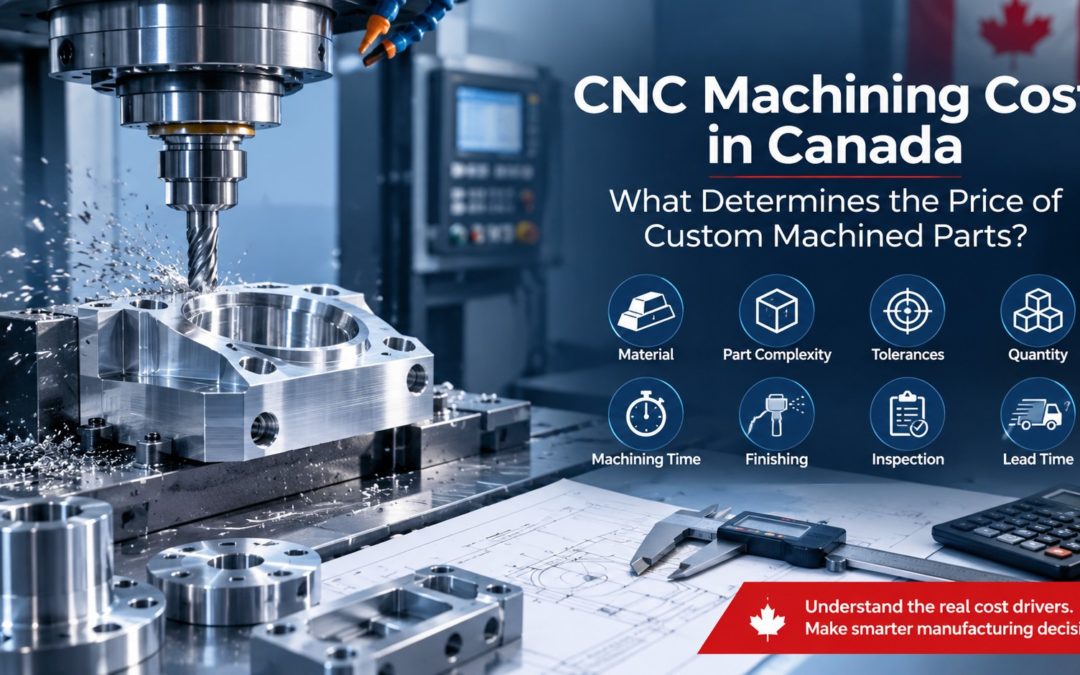
How much does CNC machining cost in Canada? It is one of the first questions most manufacturers, engineers, product developers, and purchasing teams ask when they need a custom part.
The frustrating answer is: there is no single price.
A simple aluminum bracket made in a batch of 500 pieces can have a completely different machining cost from a one-off titanium component with tight tolerances, complex geometry, and extensive inspection requirements – even if both parts are physically similar in size.
That is because CNC machining is not priced simply by the weight of the material or the number of hours a machine runs. A machining quote reflects the complete process required to turn a drawing or CAD model into a finished, inspected component.
For Canadian manufacturers, that can include material, programming, machine setup, tooling, machining time, labour, inspection, finishing, packaging, and other production requirements.
Understanding these factors can make it much easier to compare CNC machining quotes, identify opportunities to reduce costs, and work with a machine shop more effectively.
This guide explains what actually determines the cost of CNC machined parts in Canada – and what you can do before requesting a quote to keep the project economical without compromising the part’s function.
Is There an Average Cost for CNC Machining in Canada?
Not really.
You may find online calculators or articles suggesting a standard hourly CNC machining rate or a typical price per part. These can be useful for very early budgeting, but they should not be treated as a reliable quotation for a real manufacturing project.
A CNC machine shop has to consider the actual manufacturing requirements of your part.
For example, two parts may both require CNC milling, but one might:
- Be made from readily machinable aluminum
- Require only standard tolerances
- Have relatively simple geometry
- Need one setup
- Require no secondary finishing
- Be ordered in quantities of several hundred
The other might:
- Use titanium or a difficult-to-machine alloy
- Require very tight tolerances
- Include deep pockets or thin walls
- Need several setups
- Require specialized tooling
- Need CMM inspection
- Require anodizing, plating or another finishing process
- Be needed urgently in a small quantity
Naturally, their prices will be very different.
That is why a professional CNC quote is based on the specific part and production requirements, rather than a generic price list.
MDA Ltd., for example, states that its pricing considers setup and programming, raw material, machining, post-machining work, and non-recurring expenses. The company can quote from CAD files, PDF drawings, samples, or even conceptual requirements.
The Main Factors That Determine CNC Machining Cost
Although every project is different, most CNC machining quotes can be understood by looking at several major cost drivers.
The most important include:
- Material selection
- Part size and material usage
- Part complexity and geometry
- CNC machine and process selection
- Setup and programming
- Machining time
- Tolerances and GD&T
- Surface finish and secondary operations
- Tooling and workholding
- Quantity and production volume
- Inspection and documentation
- Lead time
- Packaging, shipping and other project requirements
Let’s look at each one.
1. Material Choice Has a Major Impact on Cost
The material specified for a part affects much more than the price of the raw stock.
It can also determine:
- How quickly the material can be machined
- Tool wear
- Cutting parameters
- Machining time
- Coolant requirements
- Workholding requirements
- Finishing requirements
- Material waste
For example, aluminum is generally easier and faster to machine than many harder alloys. Titanium and certain high-performance materials can require more careful machining strategies, specialized tooling, and slower cutting conditions.
MDA works with a range of materials, including aluminum, steel, stainless steel, brass, copper, industrial plastics, and exotic alloys.
Why material price alone can be misleading
Imagine two materials:
Material A
- Lower raw-material price
- Fast machining
- Lower tool wear
Material B
- Higher raw-material price
- Slower machining
- Higher tool wear
- More demanding cutting conditions
Even if the difference in raw stock price isn’t enormous, Material B may produce a significantly higher overall manufacturing cost because of the additional machining requirements.
This is why material selection should be considered from both a performance perspective and a manufacturability perspective.
If your engineering requirements allow more than one material, it can be worth discussing the options with the machine shop before finalizing the design.
2. Part Size and Material Waste Matter
The amount of material required to make the finished component also affects cost.
CNC machining is a subtractive manufacturing process. Material is removed from a piece of stock until the desired geometry is produced.
If a finished component is relatively small but must be machined from a much larger block, there may be considerable material waste.
For example, a part measuring approximately 50 mm × 50 mm may not necessarily be machined from a block of exactly that size. The machinist may need additional stock for:
- Fixturing
- Workholding
- Cutting
- Facing
- Tool access
- Maintaining dimensional accuracy
Large parts can therefore have substantial raw-material costs before machining even begins.
This becomes particularly important when using expensive alloys.
3. Part Complexity Can Increase Machining Cost Quickly
Geometry is one of the most important factors in CNC machining economics.
A simple rectangular component may require relatively few operations. A component containing multiple pockets, angled surfaces, undercuts, holes, threads, and complex contours may require significantly more work.
Complex geometry can increase:
- Programming time
- Number of machining operations
- Number of setups
- Tool changes
- Machining time
- Inspection requirements
- Risk of tool interference
- Scrap or rework risk
A useful rule is:
The more operations required to produce the finished part, the more opportunities there are for manufacturing cost to increase.
This does not mean complex parts should be avoided. Sometimes the geometry is necessary for the function of the product.
The objective is to determine whether every feature is actually needed.
Features That Commonly Increase CNC Machining Cost
Several design features can make a component more expensive to manufacture.
Deep pockets
Deep cavities can require longer cutting tools. Long tools can be more susceptible to vibration and deflection, which may require slower machining conditions.
Thin walls
Very thin walls can be difficult to machine without distortion or vibration. The machinist may need to remove material gradually and use more conservative cutting parameters.
Tight internal corners
Standard milling cutters are round, so producing a very sharp internal corner may require smaller tools or additional operations.
Undercuts
Undercuts can require specialized tooling or different machine configurations.
Multiple orientations
If a part must be repositioned several times, each additional setup adds labour and machine preparation time.
Complex 3D surfaces
Freeform surfaces can require more sophisticated CAM programming and longer finishing cycles.
This is why design for manufacturability (DFM) is such an important part of controlling CNC costs.
4. Choosing the Right CNC Process Affects the Quote
Not every part should be manufactured using exactly the same machining strategy.
Depending on the geometry, a project may involve:
- CNC milling
- CNC turning
- CNC lathe operations
- Multi-axis machining
- 5-axis machining
- Drilling
- Threading
- Secondary machining operations
The objective is not necessarily to use the most advanced machine available.
It is to use the most appropriate process for the part.
For example, a simple cylindrical component may be naturally suited to turning, while a complex prismatic component with features on several faces may benefit from multi-axis machining.
MDA provides CNC milling and turning services and also offers 5-axis CNC machining for complex components.
A good manufacturing partner can evaluate the geometry and determine an efficient production strategy rather than simply applying the same process to every project.
5. Setup and Programming Costs Are Especially Important for Small Orders
One of the biggest misunderstandings about CNC machining is assuming that ordering one part should cost roughly the same per unit as ordering 100 parts.
It usually doesn’t.
Before the first part can be machined, the shop may need to:
- Review the drawing
- Review the CAD model
- Plan the manufacturing process
- Program the CNC machine
- Select tooling
- Prepare workholding
- Load material
- Set machine offsets
- Establish inspection requirements
- Run and verify the first piece
These activities can create fixed or semi-fixed costs.
If you order one part, the entire setup burden is effectively carried by one part.
If you order 100 parts, that setup cost can be distributed across the production run.
A simple example
Suppose a hypothetical job requires $800 in setup and programming.
If you order:
- 1 part: $800 of setup cost per part
- 10 parts: $80 per part
- 100 parts: $8 per part
- 1,000 parts: $0.80 per part
These figures are only an illustration – not a CNC pricing formula – but they demonstrate why production volume can have such a large effect on unit cost.
This relationship between fixed setup costs and production quantity is one of the reasons prototypes and one-off components can have a much higher unit price than repeat production parts.
6. Machining Time Is a Major Cost Driver
Once the machine is running, the amount of time required to produce the part becomes a major component of the quote.
Machining time depends on things such as:
- Material
- Part geometry
- Amount of material removed
- Cutting conditions
- Number of operations
- Tool changes
- Machine configuration
- Finishing requirements
- Required accuracy
A simple part that can be produced quickly may cost considerably less than a complex part that occupies a machine for several hours.
This is why reducing unnecessary machining time can be one of the most effective ways to reduce the final cost.
Current machining-industry guidance similarly identifies machining time, setup, material, tolerances, complexity, and inspection among the primary cost drivers.
7. Tolerances Can Change the Cost of a Part
Tolerances specify how much variation is acceptable in a dimension.
For example, a drawing might specify a dimension with a relatively broad tolerance for a non-critical feature while requiring a much tighter tolerance for a bearing location or precision interface.
The tighter the requirement, the more carefully the manufacturing process may need to be controlled.
Tight tolerances can increase cost through:
- Slower machining
- Additional finishing operations
- Additional inspection
- More careful workholding
- Temperature considerations
- Additional process controls
- Increased risk of rejected or reworked parts
The key question is:
Does every dimension really need an extremely tight tolerance?
If the answer is no, relaxing non-critical tolerances can sometimes reduce manufacturing cost without affecting product performance.
This is one area where an experienced machinist or manufacturing engineer can provide valuable input during design review.
8. GD&T and Inspection Requirements Influence Cost
Geometric Dimensioning and Tolerancing (GD&T) provides a structured way to communicate requirements for form, orientation, location, and other geometric characteristics.
Proper GD&T can improve manufacturing communication and prevent ambiguity.
However, specialized requirements can also affect the manufacturing and inspection process.
For example, a project may require:
- Detailed dimensional reports
- First Article Inspection (FAI)
- CMM inspection
- Material certificates
- Certificates of compliance
- Process documentation
- Additional traceability
These requirements are not simply paperwork. They require time, equipment, and qualified personnel.
MDA states that its quality system is certified to ISO 9001:2015 by Intertek and that it uses calibrated measurement equipment, including micrometers, calipers, gauge pins, thread gauges, height gauges, hardness and surface testers, as well as a FARO Arm CMM.
ISO explains that ISO 9001 provides a framework for a quality management system, including requirements around processes, resources, performance evaluation, and continual improvement.
For a customer, the important point is that quality requirements should be considered part of the manufacturing scope – not something added after the machining process.
9. Surface Finish and Post-Machining Operations Add Cost
The machining process may produce the required geometry, but the part may still need additional work.
Depending on the application, this could include:
- Anodizing
- Plating
- Powder coating
- Painting
- Polishing
- Deburring
- Passivation
- Heat treatment
- Surface finishing
- Laser marking
- Assembly
Each additional operation introduces another manufacturing step, supplier, or process requirement.
That does not mean finishing should be eliminated. If the component requires corrosion resistance, wear resistance, appearance, or a particular functional surface, finishing may be essential.
The important point is to specify only the finish the application actually requires.
10. Tooling and Workholding Can Affect Small or Complex Jobs
Tooling is another cost that can be easy to overlook.
Most standard CNC jobs can use commonly available cutters and tooling. More specialized geometries may require:
- Special cutters
- Long-reach tools
- Small-diameter tools
- Form tools
- Custom fixtures
- Specialized workholding
Workholding is particularly important because the part must be securely positioned throughout machining.
A simple part may be held using standard equipment.
A complicated part may require a custom fixture or several different setups.
Those additional requirements can increase both setup time and overall production cost.
11. Production Quantity Has a Huge Effect on Unit Cost
Quantity is one of the most important factors when comparing CNC machining prices.
The relationship is not always linear.
A one-off prototype may be relatively expensive because setup and programming costs are spread across one part.
As production volume increases, those initial costs can be distributed across more parts.
However, larger quantities can also create opportunities for:
- Process optimization
- Dedicated fixtures
- Better tool management
- Repeatable setups
- Batch processing
- Automated inspection
- Improved material purchasing
- More efficient production planning
This is why it is important to tell your machine shop not only how many parts you need today, but also whether the project is likely to become a recurring production program.
MDA indicates that it supports both low- and high-volume orders and can accommodate blanket and just-in-time orders.
12. Rush Orders and Lead Time Can Affect Cost
Sometimes a component is needed immediately.
A production problem, equipment failure, or customer deadline may make a standard lead time unacceptable.
Expedited machining can require:
- Rescheduling existing work
- Overtime
- Expedited material purchasing
- Priority programming
- Faster outside processing
- Additional coordination
As a result, a rush order may carry additional cost compared with a normally scheduled production run.
If you know your requirements well in advance, giving the machine shop sufficient planning time can often help control costs.
MDA notes that lead times vary according to shop load, while its quoting and service information emphasizes fast response and production support.
13. Inspection and Quality Requirements Are Part of the Real Cost
A quality machined component is not simply cut and shipped.
Depending on the project, inspection may take place:
- During setup
- During machining
- After machining
- Before finishing
- After finishing
- Before shipment
The level of inspection required depends on the component and its application.
A straightforward industrial bracket may require basic dimensional verification.
A highly precise component for a demanding application may require much more extensive inspection and documentation.
This is particularly relevant for industries where traceability and documented quality are important.
For buyers, the lesson is simple:
Do not compare two CNC quotes only by the machining price if their quality and inspection scopes are different.
A lower quote may not represent the same deliverable.
What About Labour and Machine Hourly Rates?
Labour and machine operating costs are built into a machine shop’s overall pricing structure.
Canadian labour costs are one part of the broader economics of machining. Government of Canada’s Job Bank, for example, reports national wage data for metal machining occupations, with the published figures varying by occupation and region.
But it would be misleading to take an hourly wage and assume that it represents the hourly rate a CNC shop charges.
A shop’s actual operating cost can include:
- Skilled labour
- CNC machine depreciation
- Maintenance
- Tooling
- Electricity
- Facility costs
- Software
- Quality equipment
- Programming
- Administrative costs
- Insurance
- Training
- Material handling
- Production planning
This is why comparing machine shops based solely on their advertised or implied hourly rate can produce a misleading result.
The better comparison is the total delivered cost for the required part and quality level.
Why Two CNC Shops Can Give You Different Quotes
It is normal for two reputable machine shops to return different prices for the same part.
That does not automatically mean one shop is overcharging.
They may be using different:
- Machines
- Tooling strategies
- CAM approaches
- Material suppliers
- Production schedules
- Labour structures
- Inspection processes
- Finishing suppliers
- Overhead models
- Production assumptions
One shop may also identify a more efficient way to manufacture the component.
The better question is not:
Why isn’t everyone’s quote the same?
Instead ask:
What assumptions and processes are behind each quote?
That makes quote comparison much more meaningful.
How to Reduce CNC Machining Costs Without Sacrificing Quality
Cost reduction does not necessarily mean asking the machine shop for a lower margin.
In many cases, the biggest savings come from improving the part itself.
Here are some practical approaches.
1. Avoid Unnecessary Tight Tolerances
Use tight tolerances where function requires them.
Avoid specifying extremely tight tolerances simply because the machine is capable of achieving them.
2. Simplify the Geometry Where Possible
Ask whether every pocket, contour, hole, undercut, or feature is necessary.
A small design change can sometimes eliminate an entire machining operation.
3. Minimize the Number of Setups
If the component can be designed or oriented so more features can be produced in fewer setups, manufacturing time may decrease.
4. Choose a Practical Material
If several materials meet the engineering requirements, compare not just material prices but also machinability and availability.
5. Standardize Hole and Thread Sizes
Using common tooling and standard thread sizes can simplify production.
6. Avoid Extremely Deep or Narrow Features
Deep pockets, narrow slots, and thin walls can require specialized tooling and slower machining.
Where the design allows it, increasing accessibility can make machining easier.
7. Plan for Production Volume
Tell your supplier if a prototype is expected to become a production order.
The best strategy for making one prototype may not be the best strategy for producing 1,000 parts.
8. Provide Complete Documentation
A complete drawing and CAD model can reduce clarification, programming, and quoting time.
Include:
- Material
- Quantity
- Dimensions
- Tolerances
- Surface finish
- Threads
- Heat treatment
- Coatings
- Inspection requirements
- Delivery requirements
What Should You Send a Canadian CNC Machine Shop for an Accurate Quote?
The more complete your RFQ package, the easier it is for a machine shop to understand the job and provide an accurate quotation.
Ideally, provide:
CAD model
A 3D CAD file gives the manufacturer a clear representation of the component.
2D manufacturing drawing
The drawing should communicate dimensions, tolerances, material, finishes, and other requirements that may not be obvious from the 3D model.
Material specification
Specify the exact material or approved alternatives whenever possible.
Quantity
State both the immediate requirement and anticipated future production volume.
For example:
Prototype: 5 pieces
Initial production: 100 pieces
Estimated annual requirement: 1,000 pieces
That information can help the manufacturer consider an appropriate production strategy.
Finishing requirements
Identify any anodizing, plating, heat treatment, coating, or other secondary operations.
Inspection requirements
State whether you require:
- Standard inspection
- Inspection report
- CMM report
- FAI
- PPAP
- Material certification
- Certificate of compliance
- Other documentation
Delivery requirements
Include your required delivery date and shipping destination.
CNC Machining Cost: A Simple Way to Think About the Quote
A useful conceptual model is:
Total project cost = Material + Setup/Programming + Machining + Tooling + Finishing + Inspection + Other required services
And:
Unit cost = Total project cost ÷ Quantity
This is not a universal quoting formula because different machine shops structure their quotes differently. It is simply a useful framework for understanding what is behind a CNC quotation. Current industry pricing guides use similar cost-driver models when explaining CNC machining economics.
The important thing is that quantity changes how fixed costs are distributed.
For low-volume work, setup and programming can have a large effect on unit price.
For higher-volume production, machining time, material, tooling efficiency, and process optimization can become increasingly important.
Prototype CNC Machining vs. Production Machining
The cheapest manufacturing strategy for a prototype is not necessarily the cheapest strategy for production.
For a prototype, you may prioritize:
- Speed
- Flexibility
- Design validation
- Low upfront investment
For production, you may prioritize:
- Repeatability
- Cycle time
- Tool life
- Automation
- Fixture efficiency
- Material purchasing
- Inspection efficiency
- Consistent lead times
A good CNC partner should be able to help you transition between these stages.
MDA’s CNC machining services cover both low- and high-volume production and include milling, turning, and other machining capabilities.
Why Design Review Can Save More Money Than Negotiating the Quote
One of the most valuable conversations you can have with a CNC manufacturer should happen before production begins.
If a machinist identifies a feature that takes 20 minutes to produce but provides little functional value, changing that feature during design may save money across every future part.
If you are producing 2,000 units, a small saving on each component can become substantial.
This is why design-for-manufacturing review can be more valuable than simply negotiating the quoted price.
At MDA, the company says its engineering team can assist with customer questions and that its approach includes design optimization, material guidance, and process efficiency.
Why the Cheapest CNC Quote Is Not Always the Lowest-Cost Option
Price matters.
But when selecting a CNC machining partner, the cheapest initial quotation may not always produce the lowest total cost.
Consider the consequences of:
- Late deliveries
- Dimensional problems
- Rejected parts
- Rework
- Poor communication
- Inconsistent batches
- Unclear inspection documentation
- Unexpected finishing costs
- Difficult reorders
A slightly higher initial quote may provide better value if it delivers consistent quality, predictable production, and fewer downstream problems.
For production customers, total cost of ownership can matter much more than the first purchase price.
What to Look for When Comparing CNC Machining Quotes
When you receive multiple quotes, compare them line by line.
Ask:
Is the same material being quoted?
Confirm the exact alloy or grade.
Is the quantity the same?
Check whether each supplier has quoted the same number of parts.
Are setup and programming included?
A low-looking unit price may exclude certain upfront costs.
Are finishing operations included?
Make sure anodizing, plating, heat treatment, or other requirements have not been omitted.
Is inspection included?
Confirm whether inspection reports or other documentation are part of the quote.
Is the delivery date comparable?
A quote with a much longer lead time isn’t necessarily equivalent to one that meets your required schedule.
Are tooling or fixtures included?
Check whether special tooling is charged separately.
Are shipping and packaging included?
Determine whether the quoted price is delivered or whether additional logistics costs apply.
Why Canadian CNC Machining Can Be a Strategic Choice
For Canadian companies, the decision to use a Canadian CNC supplier is not necessarily about geography alone.
It can also be about communication, engineering collaboration, quality control, logistics, and responsiveness.
Working with a local or Canadian manufacturing partner can make it easier to:
- Discuss engineering changes
- Resolve production questions
- Review prototypes
- Manage urgent requirements
- Coordinate repeat orders
- Reduce communication delays
- Maintain closer supplier relationships
This can be particularly important for complex or continuously evolving projects.
MDA is located in Concord, Ontario, just north of Toronto, and has been operating since 1963. The company describes its focus as providing custom machined products while maintaining long-term customer relationships.
How MDA Approaches Custom CNC Machining
For customers looking for a Canadian CNC machining partner, MDA provides CNC milling, CNC turning, and other machining services for custom components.
Its stated capabilities include support for low- and high-volume production, material-specific machining and sub-assemblies.
MDA also states that its Quality Management System is certified to ISO 9001:2015 by Intertek and that it uses calibrated inspection equipment and CMM technology for dimensional verification.
For customers, this means the discussion does not have to start and end with:
How much does this part cost?
A more productive conversation is:
What is the most efficient way to manufacture this part to the required specification, quantity, and quality level?
That shift can uncover opportunities to improve the design, select a more practical material, reduce unnecessary operations, and establish a more efficient production process.
Frequently Asked Questions About CNC Machining Cost
How much does CNC machining cost in Canada?
There is no universal price because CNC machining cost depends on material, part geometry, machining time, setup, quantity, tolerances, finishing, inspection, and delivery requirements.
The most accurate approach is to submit the part’s CAD model or drawing along with the quantity and specifications for a project-specific quotation.
What is the biggest factor affecting CNC machining cost?
There is no single factor that dominates every project. Machining time and complexity can be major drivers, while setup costs can have a particularly large effect on low-volume jobs. Material, tolerances, finishing, inspection and quantity also have significant effects.
Is CNC machining cheaper for larger quantities?
Generally, the cost per part can decrease as quantity increases because setup and programming costs can be distributed across more components. However, the exact savings depend on the production process, material, geometry, and volume.
Does aluminum cost less to CNC machine than steel?
Not necessarily in every situation, but aluminum is often relatively easy to machine. The actual cost depends on the specific alloy, stock size, part geometry, tolerances, machining strategy, and quantity.
Do tight tolerances increase CNC machining costs?
They can. Tighter tolerances may require more careful machining, additional inspection, slower processes, or additional finishing operations.
The best practice is to apply tight tolerances only where they are functionally necessary.
Does surface finishing affect CNC machining cost?
Yes. Processes such as anodizing, plating, polishing, passivation, painting, and heat treatment can add cost because they require additional processing.
Is prototype CNC machining more expensive per part?
Often, yes. Setup and programming costs are spread over fewer parts, making the unit cost higher for one-off or small-batch projects.
What files are needed for a CNC machining quote?
A 3D CAD model and 2D manufacturing drawing are ideal when available. You should also provide material, quantity, tolerances, surface finish, inspection requirements, and delivery expectations.
MDA states that it can quote from CAD files, PDF drawings, samples, or conceptual ideas.
Final Thoughts: The Best Way to Control CNC Machining Cost
The price of a custom CNC machined part is ultimately a reflection of the work required to produce it correctly.
Material matters.
Geometry matters.
Tolerances matter.
Quantity matters.
Machining time matters.
But the biggest opportunity for cost control often comes from making good manufacturing decisions before production begins.
A well-designed part with practical tolerances, appropriate material, efficient geometry, and a sensible production volume can often be manufactured more efficiently than a part that has unnecessary complexity built into the design.
If you are developing a prototype, sourcing replacement components or planning a recurring production program, it is worth discussing the project with your machine shop early.
At MDA Ltd., customers can submit CAD files, drawings or project requirements for a custom quotation. The company provides CNC milling, CNC turning, and related machining services and supports projects ranging from prototypes and low-volume requirements to larger production programs.
Have a custom component you need manufactured? Submit your drawings, CAD files, and quantity requirements to MDA for a project-specific CNC machining quote.