Choosing a CNC machine shop is about much more than finding the lowest price per part.
For engineers, procurement teams, product developers, OEMs, and businesses sourcing custom machined parts, the right manufacturing partner can directly affect product quality, development timelines, production costs, and the ability to scale from a prototype to repeat production.
A supplier may be able to machine your part, but that does not necessarily mean it is the right supplier for your project.
Can the shop hold your required tolerances? Does it have the right CNC equipment? Can it work with your material? Does it have the inspection capability to verify the finished parts? Can it support both prototypes and production quantities? What happens when your design changes? Can it handle finishing, assembly, packaging, and shipping?
These are the questions that matter before you request a CNC machining quote.
This guide explains 10 important questions to ask when evaluating a CNC machine shop in Canada, along with what you should look for in the answers and how MDA approaches each consideration.
Why Choosing the Right CNC Machine Shop Matters
A CNC machining supplier becomes part of your manufacturing process.
The quality of that relationship can affect:
- Part accuracy and consistency
- Product development timelines
- Prototype iterations
- Production capacity
- Material sourcing
- Quality documentation
- Inspection and traceability
- Finishing and assembly
- Shipping and logistics
- Total manufacturing cost
- Ability to scale production
For a one-off prototype, you may prioritize engineering support and fast iteration. For an ongoing production program, consistency, capacity, quality systems, lead-time reliability, and supply-chain support may become more important.
The best CNC machine shop is therefore not necessarily the one with the lowest initial quote. It is the one that can reliably meet the technical, commercial, quality, and delivery requirements of your project.
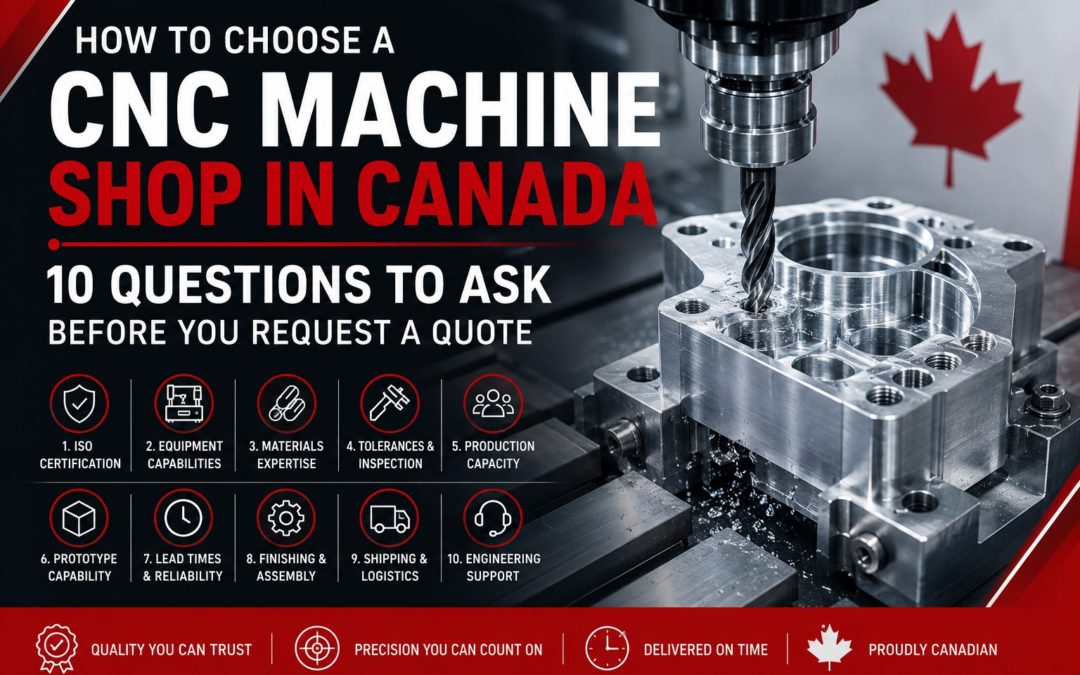
Quick Checklist: 10 Questions to Ask a CNC Machine Shop
| Question | What You Should Evaluate |
|---|---|
| 1. Is the shop ISO certified? | Quality management system, certification, documentation, and process control |
| 2. Does the shop have the right equipment? | CNC turning, milling, multi-axis capabilities, machine capacity and technology |
| 3. Can it machine my material? | Aluminum, steel, stainless steel, titanium, brass, plastics, and specialty materials |
| 4. Can it achieve and verify my tolerances? | Machining capability, inspection equipment, and measurement processes |
| 5. Can it handle my production volume? | Prototype, low-volume, medium-volume and larger production requirements |
| 6. Can it support prototyping and development? | DFM, CAD/CAM, reverse engineering, first articles and design assistance |
| 7. What is the realistic lead time? | Quoting, material procurement, programming, machining, inspection, and delivery |
| 8. Can it handle finishing and assembly? | Coating, anodizing, plating, heat treatment, assembly, packaging, and related services |
| 9. Can it manage shipping and logistics? | Domestic and cross-border shipping, packaging, blanket orders, and delivery |
| 10. Will engineers support the project? | Technical communication, manufacturability feedback, and problem-solving |
1. Is the CNC Machine Shop ISO Certified?
Quality should be one of the first things you investigate.
Ask the machine shop: What quality management system do you operate under, and is it independently certified?
ISO 9001 is an internationally recognized quality management standard. It establishes requirements for a quality management system covering areas such as operational control, documented information, performance evaluation, customer requirements, and continual improvement.
Learn more about ISO 9001 from the International Organization for Standardization.
What to Verify
- Is the certification current?
- Who issued the certification?
- What standard and edition is covered?
- What scope does the certification cover?
- How are nonconformances handled?
- How are corrective actions managed?
- How are inspection records maintained?
- How is customer feedback incorporated into the quality system?
- Can the supplier provide required quality documentation?
Certification does not automatically guarantee that every individual part will be perfect. However, an independently audited quality management system provides evidence that the organization has structured processes for managing quality rather than relying entirely on individual operators.
How MDA Approaches Quality
Machining Design Associated Ltd. states that its Quality Management System is certified to ISO 9001:2015 by Intertek. MDA also identifies dedicated quality personnel, calibrated measuring equipment, a dedicated inspection room, CMM equipment, a Mitutoyo Shadow Graph, pin gauges, hardness testing equipment, and other inspection devices.
View MDA’s Quality Assurance capabilities.
MDA has also stated that it has been ISO registered since 2002.
See MDA’s FAQ and manufacturing information.
Important 2026 note: ISO has a new ISO 9001 edition under publication in September 2026, expected to replace ISO 9001:2015. When evaluating any supplier, verify the current certificate and its scope rather than assuming that an older certification claim remains unchanged.
2. Does the Shop Have the Right CNC Equipment for Your Parts?
A machine shop can have modern CNC machines and still be the wrong fit for your particular component.
The important question is not simply whether the supplier has CNC machines. It is whether it has the right machines for your part’s geometry, size, material, tolerance, and production requirements.
CNC Milling
CNC milling is suitable for components with:
- Pockets
- Slots
- Holes
- Flat surfaces
- Complex profiles
- 3D features
- Angled surfaces
- Multiple-sided features
CNC Turning
CNC turning is generally appropriate for:
- Shafts
- Bushings
- Pins
- Sleeves
- Threaded components
- Cylindrical parts
- Rotational components
Multi-Axis Machining
Complex parts may benefit from 4-axis, 5-axis, or other multi-axis machining strategies.
Multi-axis machining can reduce the number of setups required and provide access to complex surfaces that would otherwise be difficult to machine efficiently.
But more axes do not automatically mean better or cheaper machining. A simple component may be more economical on a conventional CNC machine, while a complex component may benefit significantly from multi-axis machining.
What to Ask
- What types of CNC mills do you operate?
- What CNC turning capabilities do you have?
- Do you have 4-axis or 5-axis capability?
- What is the maximum part size?
- What is the maximum turning diameter?
- What materials can the machines handle?
- Can the shop accommodate complex geometries?
- What types of workholding are available?
- Does the shop select the most appropriate machine for each job?
MDA’s Capabilities
MDA describes its machining capabilities as including CNC turning and milling, with turning equipment reaching up to six axes and multi-axis milling capabilities. Its CNC services also cover screw machining and complex custom parts.
Explore MDA’s machining capabilities.
For 5-axis work, MDA states that it produces prototypes and low-volume parts and supports materials including aluminum, titanium, steel, copper, stainless steel, brass, bronze, and exotic alloys.
Learn more about MDA’s 5-axis CNC machining.
3. Can the CNC Machine Shop Work With Your Material?
Material selection has a direct impact on machining, cost, tool life, surface finish, dimensional stability, and final part performance.
Before requesting a quote, clearly identify the material and grade required.
For example:
- Aluminum 6061-T6
- Aluminum 7075
- Stainless steel 304
- Stainless steel 316L
- Steel 4140
- Brass
- Copper
- Titanium Grade 5
- PEEK
- Acetal/POM
- Nylon
- Engineering composites
Simply writing aluminum or stainless steel may not provide enough information for a production quotation.
Ask the Shop
- Do you regularly machine this material?
- Can you source the required grade?
- Can you work with the specified temper or condition?
- Do you have experience with difficult-to-machine materials?
- Can you provide material certification if required?
- Can you maintain the required finish and tolerances in this material?
- Are there alternative materials that could reduce cost without compromising performance?
MDA’s Material Capabilities
MDA identifies a broad range of machining materials, including aluminum, steel, stainless steel, brass, bronze, copper, plastics, titanium, and exotic alloys.
See MDA’s machining and material capabilities.
If material selection is still uncertain, see MDA’s guide on Selecting Materials for Machining: A Complete Guide.
4. Can the Shop Achieve – and Prove – Your Required Tolerances?
One of the most important questions to ask is:
What tolerances can you reliably achieve and how will you verify them?
There is a major difference between saying a machine can physically produce a dimension and demonstrating that the supplier can consistently manufacture and inspect the feature within specification.
Start With Your Actual Requirements
Not every feature needs an extremely tight tolerance.
- General dimensional tolerances
- Tight positional tolerances
- Hole tolerances
- Shaft tolerances
- Flatness requirements
- Parallelism
- Perpendicularity
- Concentricity
- Surface-finish requirements
- GD&T callouts
The machine shop should understand which characteristics are genuinely critical to function.
Ask About Inspection Capability
- What measuring equipment is available?
- Is the equipment calibrated?
- Can critical dimensions be inspected in-house?
- Is CMM inspection available?
- Can first-article inspection be performed?
- Can final inspection reports be supplied?
- Can material and inspection records be maintained?
- How are nonconforming parts controlled?
MDA’s Inspection Capabilities
MDA states that it maintains a dedicated inspection room and full-time quality inspection personnel backed by engineering support. Its listed equipment includes CMM capability, a Mitutoyo Shadow Graph with edge detector, pin gauges, hardness testing equipment, calibrated measuring devices, and a Keyence IM-7000 inspection system.
Review MDA’s quality and inspection capabilities.
MDA also states that it can provide documentation such as PPAPs, first-article inspection, final inspection reports, and certificates of compliance when requested.
Key takeaway: Machining and inspection should be evaluated together. A supplier should not simply manufacture a part and tell you that it is within tolerance. It should have a defined way to verify the characteristics that matter.
5. Can the Shop Handle Your Production Volume?
Your requirements may start with one prototype and eventually become thousands of production components. That makes scalability an important consideration.
Ask: Can you support the quantity I need today – and the quantity I may need later?
Prototype Quantities
You may initially need one part, five parts, ten parts, or a small engineering batch. At this stage, flexibility and engineering support can be more important than maximum production capacity.
Low-Volume Production
As the product moves toward commercialization, you may need dozens or hundreds of parts. The supplier must be able to maintain consistency while controlling setup, tooling, inspection, and material costs.
Larger Production Programs
For established products, you may require thousands of parts or recurring blanket orders. At this stage, capacity, repeatability, inventory planning, quality documentation, scheduling, and logistics become increasingly important.
Ask About
- Minimum order quantities
- Maximum production volume
- Available machine capacity
- Scheduling
- Repeat orders
- Blanket orders
- JIT requirements
- Inventory storage
- Production scalability
- Capacity during peak periods
MDA’s Production Range
MDA states that it can produce quantities ranging from one piece to thousands of pieces and supports both small and larger production requirements.
Review MDA’s production and machining FAQs.
MDA also offers blanket-order and JIT capabilities, allowing larger quantities to be manufactured and stored for scheduled shipment.
Learn more about MDA’s post-production and delivery capabilities.
6. Can the Shop Support Prototyping and Product Development?
A machine shop can either be simply a production vendor—or a manufacturing partner. For companies developing new products, the second option can be significantly more valuable.
Ask: “Can your engineers or manufacturing team review my design before production?”
Useful Engineering Support Can Include
- Design for Manufacturability (DFM)
- Material recommendations
- Machining-method selection
- Tolerance review
- Feature-access review
- Workholding considerations
- Tooling considerations
- Prototype development
- Reverse engineering
- CAD/CAM support
- First-article development
Why DFM Matters
A part can be technically manufacturable but still be unnecessarily expensive.
- Extremely tight tolerances may be specified where they are not functionally necessary.
- Deep pockets may require specialized tooling.
- Thin walls can increase machining difficulty.
- Complex geometry may require additional setups.
- Difficult-to-access features may increase cycle time.
- An unnecessarily expensive material may be specified.
- Certain finishes may add cost without providing meaningful functional benefit.
A good machining partner should be willing to discuss these issues before the quotation becomes a purchase order.
MDA’s Engineering and Prototype Support
MDA states that its planning and design-development services include product consultation, CAD/CAM design, and prototype development. Its engineering and quality personnel can assist with prototype or first-article parts, design advice, and reverse engineering using inspection equipment and software such as SolidWorks and DesignWorks.
Explore MDA’s engineering and manufacturing capabilities.
7. What Is the Realistic Lead Time?
Fast turnaround is not a sufficiently useful answer. Instead, ask:
What is the expected lead time for my specific project, and what factors could change it?
A CNC project may involve several stages:
- Quote preparation
- Engineering review
- Customer approval
- Material procurement
- Programming
- Workholding or fixture preparation
- CNC machining
- Secondary operations
- Inspection
- Finishing
- Assembly
- Packaging
- Shipping
A delay at any stage can affect the final delivery date.
Ask the Supplier
- How long does quoting typically take?
- Is the material currently available?
- What is the machining lead time?
- Are finishing services included in the quoted lead time?
- Is inspection included?
- Does the quoted lead time begin after purchase-order approval?
- What happens if the design changes?
- How are urgent requirements handled?
- How is production scheduling communicated?
Do not choose a supplier based solely on the shortest promised lead time. A realistic and consistently achieved lead time is usually more valuable than an aggressive estimate that is repeatedly missed.
MDA notes that lead times vary depending on current shop loads, so project-specific scheduling should be confirmed during the quotation process.
See MDA’s FAQ for additional manufacturing information.
8. Can the Shop Handle Finishing, Coating, and Assembly?
Your requirement may not actually be for a machined part. It may be for a finished component ready to install.
After CNC machining, your components may require:
- Anodizing
- Hardcoat anodizing
- Passivation
- Plating
- Black oxide
- Powder coating
- Painting
- Polishing
- Bead blasting
- Tumbling
- Heat treatment
- Deburring
- Assembly
- Sub-assembly
- Special packaging
If your machine shop only provides the machined component, you may have to coordinate multiple additional suppliers. That creates additional purchase orders, transportation, inspection points, scheduling dependencies, communication requirements, and opportunities for damage or delay.
Ask: Can you coordinate the secondary processes and deliver the finished assembly?
MDA’s Post-Production Capabilities
MDA provides post-production services including product finishing/coating and assembly/sub-assembly. Its post-production offering also includes packaging and shipping coordination.
Explore MDA’s post-production services.
MDA states that its assembly services can be customized around the project and can incorporate consultation, design, tooling, control, sub-assembly, packaging, and shipping.
This creates the possibility of using one manufacturing partner for more of the supply chain instead of coordinating every operation independently.
9. Can the Shop Handle Shipping and Logistics?
A CNC supplier is not finished with your project when the parts leave the machine. Packaging and transportation can affect the condition, timing, and total cost of the order.
This becomes especially important when shipping precision components, finished surfaces, large or delicate components, multi-part assemblies, international orders, or recurring production quantities.
Questions to Ask
- Where do you ship?
- Can you ship across Canada?
- Can you ship internationally?
- How are precision parts packaged?
- Can you accommodate customer-specific packaging?
- Can you ship partial quantities?
- Can you support blanket orders?
- Can you store completed parts?
- Can you coordinate scheduled deliveries?
- Are shipping arrangements included in the quotation?
MDA’s Shipping Capabilities
MDA states that it ships parts throughout Canada, the United States, and Mexico.
Review MDA’s shipping information.
For customers using blanket orders, MDA states that it can manufacture larger quantities, store the parts in its warehouse, and ship them as required.
See MDA’s blanket-order and delivery capabilities.
10. Will You Have Engineering Support When Problems Arise?
This is one of the most overlooked questions when selecting a CNC machine shop. Most projects do not remain completely unchanged from quotation to production.
You may discover:
- A material is unavailable.
- A tolerance is unnecessarily tight.
- A feature is difficult to machine.
- A finish is unsuitable.
- A design needs modification.
- A prototype reveals an unexpected issue.
- A production quantity changes.
- A supplier material has a different lead time.
- A component needs to be redesigned for cost reduction.
You want to know whether you can talk directly with people who understand machining and engineering—not only someone responsible for processing purchase orders.
Ask
- Do you have engineers on staff?
- Can the engineering team review drawings?
- Can the shop provide DFM recommendations?
- Can you discuss alternative materials?
- Can you help with prototype modifications?
- Can you reverse engineer existing components?
- Who will handle technical questions after the order is placed?
- Can the same team support production after the prototype stage?
MDA’s Engineering Approach
MDA states that it has engineering personnel available to assist customers and that its engineering and quality staff support prototype development, product design, reverse engineering, CAD/CAM work, and manufacturing planning.
Review MDA’s engineering support information.
The key distinction: The value of a CNC machine shop is not limited to the machine itself. The people, processes, engineering knowledge, inspection capability, and communication around the machine can have an equally significant impact on your project.
What Should You Send a CNC Machine Shop When Requesting a Quote?
Once you have identified potential suppliers, make the quotation process as clear as possible. A good RFQ helps the machine shop understand exactly what you need and reduces unnecessary back-and-forth.
Include the Following Whenever Applicable
1. CAD Files
Common formats may include STEP, IGES, SLDPRT, DWG, and DXF. MDA states that it accepts multiple electronic file formats, including DWG, DXF, IGES, and SLDPRT.
See MDA’s file-format information.
2. Engineering Drawings
Include dimensions, tolerances, GD&T, material, material condition, surface finish, thread specifications, critical characteristics, and inspection requirements.
3. Material Requirements
Specify the exact material grade and condition wherever necessary.
4. Quantity
State prototype quantity, initial production quantity, annual volume, and expected repeat-order volume.
5. Finishing Requirements
Identify anodizing, plating, passivation, heat treatment, coating, polishing, painting, or other secondary operations.
6. Quality Requirements
Specify whether you require First Article Inspection, inspection reports, Certificates of Conformance, material certificates, traceability, PPAP, or other customer-specific documentation.
7. Delivery Requirements
Include the required delivery date, delivery location, partial shipment requirements, packaging requirements, and recurring delivery schedule.
The more complete your RFQ is, the more useful the resulting quotation will be.
How to Compare CNC Machining Quotes
Price should absolutely be considered – but it should not be the only comparison point.
When comparing quotes from multiple Canadian machine shops, evaluate the complete package.
| Evaluation Factor | What to Compare |
|---|---|
| Unit price | Cost per part at the quoted quantity |
| Setup/programming | Included or charged separately |
| Material | Exact grade and condition |
| Machining process | Appropriate equipment and process |
| Tolerances | Capability and inspection method |
| Inspection | Included scope and documentation |
| Finishing | Included services and specifications |
| Lead time | Realistic production and delivery schedule |
| Engineering | DFM and technical support |
| Production capacity | Ability to scale |
| Packaging | Standard or customer-specific |
| Shipping | Destination and logistics |
| Quality system | Certification and process controls |
| Communication | Responsiveness and technical clarity |
A quote that is 10% cheaper but requires you to manage three additional suppliers may not actually be the better commercial option.
Likewise, a slightly higher unit price may be justified if the supplier provides better inspection, engineering support, finishing coordination, packaging, and reliable delivery.
This is why it is useful to evaluate total cost and total supplier value, rather than comparing unit prices alone.
Red Flags to Watch for When Choosing a CNC Machine Shop
Red Flag #1: The Shop Only Talks About Price
A low price is attractive, but a supplier should also be able to explain material, process, quality, inspection, lead time, finishing, and delivery. If price is the only differentiator being discussed, look deeper.
Red Flag #2: Vague Answers About Tolerances
Be cautious if a supplier says:
We can machine anything to any tolerance.
A professional supplier should discuss your actual tolerances, geometry, material, inspection requirements, and manufacturing process.
Red Flag #3: No Clear Inspection Process
If the supplier cannot explain how critical dimensions will be inspected, ask additional questions before proceeding.
Red Flag #4: No Engineering Input
For straightforward production parts, extensive engineering support may not be necessary. For prototypes and complex components, however, access to technical expertise can be extremely valuable.
Red Flag #5: Unrealistic Lead Times
If a supplier promises a dramatically shorter lead time than everyone else without explaining how, investigate further.
Red Flag #6: Poor Communication During Quoting
The quoting stage is often the first indication of how communication will work after the purchase order. If technical questions are ignored or responses are consistently unclear, the same problem can become more expensive once production begins.
Why a Canadian CNC Machine Shop Can Be a Strategic Manufacturing Partner
For Canadian manufacturers, choosing a local CNC machining partner can provide advantages beyond geographic convenience.
- Easier communication
- Similar business hours
- Local engineering support
- Easier coordination
- Shorter domestic transportation
- Faster problem resolution
- Local supplier relationships
- Easier site visits
- Greater visibility into production
- Simplified logistics for Canadian customers
However, location alone should never be the deciding factor. A local supplier still needs the technical capabilities, quality system, equipment, capacity, engineering support, and production processes required by your project.
The goal should be to find a capable Canadian manufacturing partner, not simply a machine shop that happens to be nearby.
Why MDA Fits These Evaluation Criteria
The purpose of this guide is not to say that every project should automatically go to one supplier. The better approach is to evaluate a CNC machine shop against the criteria that actually matter.
Based on the capabilities MDA currently publishes, its offering aligns with many of the criteria outlined above.
Quality
MDA’s Quality Management System is certified to ISO 9001:2015 by Intertek and includes dedicated quality personnel, calibrated inspection equipment, and a dedicated inspection room.
View MDA’s Quality Assurance capabilities.
CNC Capabilities
MDA provides CNC turning, milling, screw machining, and multi-axis machining, including 5-axis capabilities for suitable projects.
Explore MDA’s CNC machining capabilities.
Materials
MDA works with materials including aluminum, steel, stainless steel, brass, bronze, copper, titanium, plastics, and exotic alloys.
See MDA’s material capabilities.
Inspection
MDA lists CMM capability, Keyence IM-7000, optical inspection, hardness testing, gauges, and other calibrated measuring equipment.
Review MDA’s inspection capabilities.
Prototypes and Production
MDA supports prototype development, first-article parts, low-volume work, and production quantities ranging from one piece to thousands.
Review MDA’s production capabilities.
Engineering
MDA provides product consultation, CAD/CAM support, prototype development, reverse engineering, and engineering assistance.
Explore MDA’s engineering and manufacturing services.
Finishing and Assembly
MDA’s post-production capabilities include finishing/coating and assembly/sub-assembly services, along with packaging and shipping support.
Explore MDA’s post-production services.
Shipping
MDA states that it ships throughout Canada, the United States, and Mexico and can support blanket-order inventory and scheduled shipments.
A Simple CNC Machine Shop Evaluation Checklist
Quality
- ☐ Is the shop ISO certified?
- ☐ Can it provide certification details?
- ☐ Does it have documented quality processes?
- ☐ Are measuring instruments calibrated?
- ☐ Can it provide inspection documentation?
Equipment
- ☐ Does it have the right CNC machines?
- ☐ Can it machine the required part size?
- ☐ Does it have appropriate multi-axis capability?
- ☐ Does it have experience with your part geometry?
Materials
- ☐ Can it machine your exact material grade?
- ☐ Can it source the material?
- ☐ Can it provide material certification?
- ☐ Can it advise on alternatives?
Precision
- ☐ Can it achieve your required tolerances?
- ☐ Can it inspect critical features?
- ☐ Does it have CMM or equivalent inspection capability?
- ☐ Can it provide first-article or final inspection reports?
Production
- ☐ Can it produce your prototype quantity?
- ☐ Can it scale to production?
- ☐ Can it support recurring orders?
- ☐ Can it handle blanket or JIT orders?
Engineering
- ☐ Does it offer DFM?
- ☐ Can engineers review drawings?
- ☐ Can it support prototypes?
- ☐ Can it help resolve manufacturing problems?
Delivery
- ☐ Is the lead time realistic?
- ☐ Is material availability confirmed?
- ☐ Are finishing operations included?
- ☐ Is inspection included?
- ☐ Can the shop ship directly to your facility?
Post-Production
- ☐ Can it coordinate finishing?
- ☐ Can it provide assembly?
- ☐ Can it package components appropriately?
- ☐ Can it manage multiple secondary operations?
Final Thoughts: Choosing the Right CNC Machine Shop in Canada
Choosing a CNC machine shop should be treated as a supplier-selection decision – not simply a price comparison.
Before requesting a quote, ask the 10 questions:
- Is the shop ISO certified?
- Does it have the right CNC equipment for my parts?
- Can it machine my required material?
- Can it achieve and verify my required tolerances?
- Can it handle my production volume?
- Can it support prototyping and product development?
- What is the realistic lead time?
- Can it handle finishing and assembly?
- Can it manage shipping and logistics?
- Will I have access to engineering support?
The answers will tell you considerably more than the unit price on a quotation.
For a prototype, you may need a supplier that can help refine the design. For a production component, you may need stronger emphasis on repeatability, inspection, capacity, and delivery. For aerospace, medical, defence, or other quality-sensitive applications, certification, traceability, documentation, and inspection may become critical.
The best CNC machine shop is ultimately the one that can align its equipment, people, processes, quality system, engineering capability, production capacity, and logistics with your requirements.
Looking for a CNC Machine Shop in Canada?
For Canadian companies looking for a manufacturing partner that can support projects from design development and prototyping through CNC machining, inspection, finishing, assembly, and delivery, MDA provides an integrated range of capabilities designed around that complete workflow.
Contact MDA about your CNC machining project
Frequently Asked Questions
What should I look for in a CNC machine shop in Canada?
Look for a combination of quality certification, appropriate CNC equipment, material expertise, tolerance and inspection capabilities, production capacity, engineering support, realistic lead times, finishing and assembly options, and reliable shipping. Price is important, but it should be evaluated alongside the supplier’s overall capabilities and risk.
Is ISO certification important when choosing a CNC machine shop?
ISO 9001 certification can provide evidence that a supplier operates a structured quality management system. It does not guarantee that every part will meet every requirement, so you should also evaluate the shop’s inspection capabilities, processes, experience, and ability to meet your specific specifications.
What CNC machining capabilities should a machine shop have?
The required capabilities depend on your part. A shop may need CNC milling, CNC turning, screw machining, or multi-axis machining. Complex components may benefit from 4-axis or 5-axis machining, while simpler parts may be more economical using conventional 3-axis equipment.
How do I know if a CNC machine shop can meet my tolerances?
Ask the shop to review your engineering drawing and identify the critical tolerances. Then ask how those dimensions will be machined and inspected. A capable supplier should be able to explain both the manufacturing process and the measurement method.
Can a CNC machine shop help me select the right material?
Yes. An experienced shop can often provide useful input regarding machinability, material availability, cost, finishing, dimensional stability, and manufacturing considerations. However, the final material specification should be based on the functional and engineering requirements of the component.
Should I choose a CNC machine shop based on the lowest quote?
Not necessarily. A lower unit price may not represent the lowest total cost if the supplier has longer lead times, limited inspection capability, poor communication, or requires you to coordinate finishing and assembly with other suppliers.
Can a CNC machine shop make prototypes and production parts?
Many shops can support both, but you should confirm this before starting a project. Prototype manufacturing may require more engineering involvement and flexibility, while production programs require repeatability, capacity, process control, and scheduling.
MDA states that it supports prototype development and quantities ranging from one piece to thousands of pieces.
What files should I send when requesting a CNC machining quote?
Whenever possible, provide a 3D CAD model together with an engineering drawing containing material, dimensions, tolerances, GD&T, surface finish, threads, and other requirements. Also provide quantity, finishing requirements, inspection requirements, and delivery expectations.
MDA states that it accepts electronic formats including DWG, DXF, IGES, and SLDPRT.
Can a CNC machine shop handle finishing and assembly?
Some full-service machine shops can coordinate or provide post-production operations such as coating, anodizing, plating, heat treatment, assembly, and packaging. Confirm exactly which processes are handled directly and which are coordinated through qualified outside partners.
Where does MDA ship CNC machined parts?
MDA states that it ships parts throughout Canada, the United States, and Mexico. It also supports blanket-order inventory and scheduled shipments for applicable customers.